How Thermostats Became Everyday Household Controls
See how thermostats shifted from visible room controls to scheduled household tools, and learn how that change can shape heating habits and energy demand.
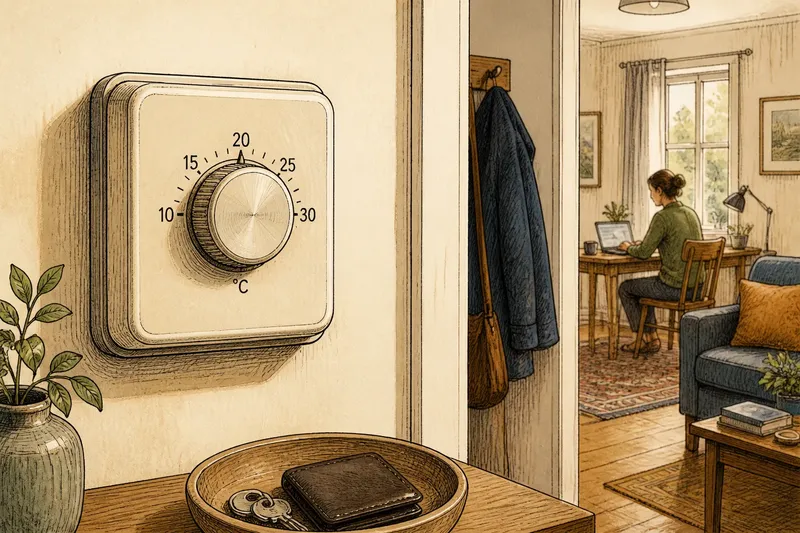
A thermostat in a hallway can look like a small switch, but it can influence when a home’s heating system runs. The history of household thermostats is best understood through that practical change: from a control adjusted by hand to a device that can follow a schedule. Each approach affects how much attention people give heating and when they ask the system to respond.
How did thermostats move from instruments to household controls?
Early temperature controls were instruments for responding to room conditions. A visible dial or scale showed a setting, and a person adjusted it when the space felt too cool or too warm. Their domestic role was direct: the control offered a way to tell a heating system when to respond.
That description explains the “room ornament” idea more clearly than the phrase itself. A wall-mounted device could be a noticeable object, but its value did not come from decoration. Its appearance and position made the control easy to find and use.
Over time, thermostats became part of systems that could manage more than an immediate adjustment. Timers and programmable controls let residents set recurring periods, shifting some decisions from the moment of discomfort to a plan made beforehand. The change was not simply from old to new equipment; it was a change in how people decided when heating should be called for.
That matters for household energy use because heating demand follows the control’s requests. A schedule that reflects when people occupy the home can avoid calling for heat at times when it is not needed. But a poorly understood schedule can prompt repeated overrides, leaving the control less useful and the household unsure what the heating system will do.
What did schedules change about heating demand?
A manual thermostat leaves the timing decision with the person using it. A programmable thermostat can make recurring decisions in advance, such as changing its setting around the household’s usual waking, leaving or returning times. The device does not know whether those plans still apply; residents need to revise them when their routine changes.
Connected or adaptive controls may add remote access or features that respond to patterns. Those functions can help if a household has a clear need for them, such as changing a setting while away. They also add another interface to understand, and should not be treated as automatically more energy-conscious than a simple control.
The practical comparison is about who manages timing:
- Manual control: A resident makes each adjustment. If daily plans vary, keep the control simple; if people repeatedly forget to change it, consider whether a recurring schedule would help.
- Programmable control: The thermostat follows periods set in advance. If household hours are fairly consistent and someone can maintain the programme, use scheduled periods; if plans change frequently, retain an easy way to override them.
- Connected or adaptive control: The thermostat may offer app access or automated responses. If remote control solves a real problem, consider these features; if nobody wants an app or account involved, choose a simpler approach.
Energy demand is shaped by the heating system, the home and its occupants, so a thermostat style alone does not determine how much energy a household uses. The useful question is whether the control calls for heat at times and in ways that fit the home’s actual routine.
How can you choose a control that fits your routine?
Look at the decisions the household makes now, rather than starting with a list of features. For each observation below, take the action linked to the result:
- Check whether people keep similar hours. If they do, draft a recurring schedule around those usual periods; if they do not, keep manual adjustments or make the schedule easy to override.
- Check whether residents understand the current control. If they can explain how to make a temporary change, keep that arrangement; if they cannot, read the instructions together before adding more settings.
- Check whether heating is requested while the home is usually empty. If that occurs, review the relevant scheduled period; if the home is occupied, do not change it solely because the control has a schedule.
- Check whether a temporary adjustment returns to the programme. If it does, show residents how to use that function; if it does not, consult the manual before changing recurring settings.
- Check whether anyone needs remote access. If a resident has a specific reason to adjust heating away from home, compare connected models; if not, a non-connected control may be easier to manage.
- Check compatibility with the heating system. If the system and thermostat maker’s guidance confirm compatibility, follow the stated installation instructions; if they do not, ask a qualified heating professional before buying or wiring a replacement.
Say a household has a manual thermostat, one resident leaves before the rest of the household, and another works at home on some days. They note that the control is changed by hand each morning, but nobody can tell whether a change lasts or resets. They first read the manual and discover that the current control has no recurring programme, so a temporary change cannot be scheduled. They check the heating system’s instructions and find that a replacement programmable control is listed as compatible; before installation, they ask a qualified professional to confirm the wiring. Their decision is to use a recurring programme only for the hours that remain predictable, while leaving variable work-at-home days adjustable. The observable result to look for is whether residents can tell what the heating will do next and whether they need fewer corrective changes. If the programme causes confusion, they can return to a simpler shared manual routine.
Compatibility is a practical boundary, not a minor detail. A thermostat that does not suit the heating system may not operate as intended, and wiring work can carry safety risks. Use the manufacturer’s instructions and seek a qualified professional where installation is uncertain.
What questions do households ask about thermostat history and use?
Does a thermostat measure every room in the home?
A thermostat generally responds to the temperature around its own sensor, rather than measuring every room. If another room feels different, the control’s reading may not represent the conditions there.
Did schedules make thermostats more energy-conscious?
Schedules gave households a way to set heating periods in advance, which can help align heating demand with occupancy. Their effect depends on how well the programme fits real routines and whether residents understand its adjustments.
Is a programmable thermostat always preferable to a manual one?
No. A programme can suit predictable hours, while a manual control can be clearer when plans change often. Choose the approach residents can operate confidently and maintain.
Why might a thermostat reading not match how a room feels?
The display reflects the sensor’s local reading, while comfort can vary elsewhere in the home. Check the product guidance about placement and consult a qualified heating professional if the location or operation appears unsuitable.
What is the lasting change in the thermostat’s household role?
The thermostat’s history is a shift in where heating decisions happen. A manual control puts the decision at the moment someone adjusts it; a scheduled model moves some decisions into a plan. That shift can affect heating demand, but only when the plan reflects the way people use the home.
For a useful starting point, write down when residents usually change the control and whether those changes should be temporary or recurring. That record can help you decide whether a manual setting, a schedule or remote access fits your household—and keep the thermostat’s effect on energy use tied to real routines rather than assumptions.