Where a Room Loses Warmth: A Plain-Language Look at Heat Flow
Heat flow shows how warmth escapes through roofs, walls, floors, windows and air leaks, helping you spot which route may deserve attention first.
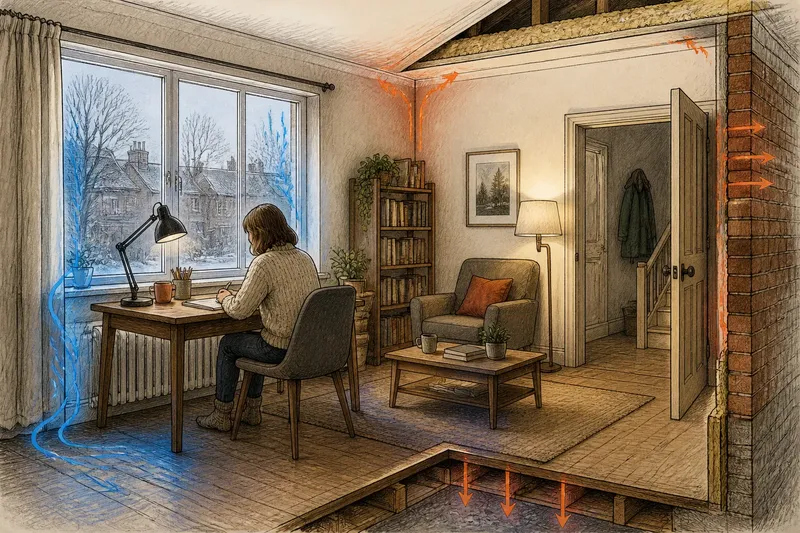
Heat loss from a room follows three main routes: through solid materials, with escaping air, and between warm people and colder surfaces. Knowing which route dominates a particular spot helps you decide whether to address draughts, a cold boundary or simply the room layout.
How does heat escape through walls, roofs and floors?
Heat conduction carries warmth through solid materials from the warmer side towards the cooler side. In a heated home, that usually means outward through external walls and the roof, and downward through floors above unheated spaces or the ground.
Insulation slows this transfer by limiting movement through the building fabric. The result depends on the complete assembly: insulation, framing, masonry, internal finishes and the joins between them. A narrow route through a structural element or junction can conduct heat more readily than the surrounding area; these routes are called thermal bridges.
Where the boundary lies matters. A wall shared with another heated room usually has less temperature difference across it than an outside wall. A ceiling below a cold roof or a floor above an unheated cellar may have a different route for heat loss than a surface adjoining a warm space.
Compare a cold patch with the surrounding surface and note whether it follows a corner, frame or junction. A surface reading can guide further investigation, but it cannot by itself identify the construction or confirm an insulation problem.
How much warmth leaves with moving air?
Air leakage carries warm indoor air out through gaps while cooler air enters elsewhere. Common places to check include door edges, window frames, pipe openings and loft hatches. The incoming air can make a nearby person feel cold even if the room’s central air temperature has changed little.
Not every cool current is a leak. Air beside a cold window can cool, become denser and sink along the glass, creating a draught-like sensation without outside air passing through the frame. A fan, extractor or open doorway can also alter air movement.
Notice whether the sensation is strongest at a narrow edge or spreads down beside a pane, and whether it changes when a fan or extractor runs. Do not block vents or openings that may provide essential ventilation or serve an appliance; check the relevant instructions and seek qualified advice if you are unsure.
Why can a cold surface make you feel chilly?
Radiant heat moves between surfaces without being carried by air. If a person sits close to a cold window or outside wall, their body exchanges heat with that surface. The air can feel acceptable while the person still feels chilled.
This is why moving a chair away from a cold pane may improve comfort without changing the heating setting. A curtain can reduce the room’s exposure to the glass when closed, but check that it does not cover a radiator or interfere with ventilation.
Floors matter too: a cold surface can make feet and lower legs uncomfortable. A rug may make the floor feel better underfoot, but it does not fix the underlying route of heat loss. Warm air collecting high in a room can also leave the occupied area feeling cooler, particularly where the ceiling is high or an open stairway connects spaces.
Which heat-loss route should you investigate first?
Start with the size and pattern of the discomfort, not an assumption that one building feature is at fault. Use these observations to choose a sensible next check; each decision has a different alternative if the clue points elsewhere.
- Observation: A narrow cold sensation follows a door or window edge. If it is strongest at the edge, then inspect the visible seal and note whether it changes with wind; otherwise, compare the broader area beside the glass for a descending cool current.
- Observation: A broad wall area feels cooler than a nearby internal wall. If the cool area is on an external boundary, then note its location and compare it with adjoining corners; otherwise, look for a local draught or another nearby source of airflow.
- Observation: A cold strip follows a corner or where a wall meets the ceiling or floor. If the pattern tracks that junction, then record it for a building professional if it persists; otherwise, compare the centre of the surface before drawing a conclusion.
- Observation: Feet feel cold while seated, but the air feels comfortable. If the floor is the uncomfortable surface, then try a rug or change where you sit; otherwise, check for a draught at ankle height.
- Observation: A chilly sensation beside glass extends downwards. If it forms a broad flow along the pane, then consider cooled air sinking; otherwise, inspect the frame area for a narrower incoming current.
- Observation: Condensation or damp returns at an outside corner or behind furniture. If it persists or mould appears, then seek suitable professional advice; otherwise, keep the area clear enough to observe whether moisture returns.
Say you work at a desk beside a window and feel cold on one side, while the room centre feels comfortable. You first notice that the sensation spreads down beside the pane rather than coming from a narrow frame edge; you then move the desk away from the glass, leaving the radiator clear. If the discomfort eases, the position and cool surface were likely contributing, so rearranging the room is a reasonable comfort response. If a distinct edge current remains, note its location and check the visible seal instead; the observations still do not establish whether the window needs repair.
A household thermometer can compare air at different heights, while a non-contact thermometer can compare surface readings. Treat both as clues rather than a diagnosis: building materials, junctions and ventilation may need assessment by a qualified professional.
What do people ask about heat loss in a room?
Why is one side of a room colder than the other?
One side may face outdoors or include a window, while another borders a warmer room. Different surfaces and air currents can make the contrast more noticeable.
Does a cold wall always mean poor insulation?
No. Exposure, construction and nearby air movement can all affect how a wall feels. Persistent cold combined with damp or draughts may justify a professional assessment.
How can I tell a window leak from air cooled by glass?
A leak often feels concentrated at a frame edge, while cooled air can descend more broadly beside the pane. These sensations can overlap, so observe the pattern without treating it as a definitive diagnosis.
Can moving furniture reduce heat loss?
Moving a chair away from a cold surface can improve comfort where you sit, but it does not alter heat transfer through the building fabric. Keep curtains and furniture clear of radiators where possible so warm air can circulate.
Heat loss in a room is easier to prioritise when you trace the discomfort to a boundary, a moving current of air or a cold surface. Make a modest room-layout change when it addresses the immediate discomfort; seek qualified advice if persistent damp, mould or a suspected building defect needs investigation.